
Four experiences learning French and integrating into Quebec
_It takes courage to leave your country and venture into the unknown. And that's something Aïcha, Rameen, Jackson and Mikayel have in abundance—their journeys are marked by unwavering determination and remarkable adaptability, despite the many challenges they've had to face. Not speaking French when they arrived in Quebec, they came here seeking a safer living environment and a promising future._
#### Immigrant Québec: Let's start with a brief introduction. Tell us why you chose Canada for your immigration journey?
Rameen Hassanzada: I'm from Afghanistan. Part of my family, including my sister, my uncle and my great-uncle live in Montréal. I was looking for a safer environment to study and work. My family strongly encouraged me to come here, convinced that Canada would offer better opportunities. I speak several languages like Dari, Persian, Urdu and Hindi. But I didn't speak French.
Aïcha Hassan Burale: As for me, I'm originally from Somalia and I didn't speak French. My mother tongue is Somali. Like Rameen, I saw Canada as a chance for a better future. I left my country to escape conflicts and economic instability. I came alone with the hope of finding a more stable environment here and opportunities to succeed.
Jackson Bogecho Mayieko: I arrived in Quebec from Kenya three years ago, sponsored by my wife. My children were already living in Montréal, as they had come to study at McGill University and stayed to work. I was also seeking better economic stability and access to healthcare.
Mikayel Ansuryan: I'm Armenian, and I was living in Russia. I didn't really know much about Quebec when I arrived in 2012. A friend with a similar background who had arrived a few years before me recommended I come. I figured it was a good option to ensure security, stability and a good future for my two children.
#### IQ: How did you overcome the challenges related to learning French and adjusting to your new life?
Aïcha: I knew almost nothing about Quebec before coming here. French is very difficult to learn, because it's so different from Somali. When I arrived, I wanted to work. I had a lot of difficulty communicating and I didn't understand enough of what people were saying to me. So I went back to school to study and really learn the language, because not speaking it wasn't an option for me. Now I can speak, read and write it, which allows me to actively look for work. The support from my teachers at CARI St-Laurent played a crucial role in my learning. Today, I really consider my experience a true discovery.
Rameen: For me, it's a bit different from Aïcha, because I had a clear idea of Quebec before arriving, thanks to the many videos sent by my sister who lives in Montréal. Even though I waited a long time before coming to live here, I already loved Canada, though I had never visited it, not even on vacation! My first time here was the day I arrived as an immigrant. Learning French wasn't too difficult either, because I already spoke several languages that I mentioned earlier.
Thanks to the commitment and support of CARI St-Laurent, French became increasingly accessible over time, and speaking French is essential to my integration! I speak French here, but also outside of school, all the time.
Mikayel: I wasn't surprised. I found Quebec to be just as I imagined it. After traveling to several countries, especially in Europe, I find that Quebec is very open and welcoming. You don't feel like a stranger or an immigrant. Everyone is like me, I feel comfortable. For my part, I started studying French at CARI St-Laurent in 2013, a few months after I arrived. The French classes were useful not only for studying the language, but also for integration. They gave us a lot of important and useful information for newcomers.
#### IQ: The settlement organization seems to play an important role in your integration journey. What did you take away from your own experience at CARI St-Laurent?
Jackson: It was my first connection in Quebec! I was at a college at first, but they sent me to CARI St-Laurent to learn French and that's how I built my network. The school is a living environment—you make friends, build a network. We celebrate there, we talk. It's a microcosm.
The courses are offered by the Government of Quebec. This allows us not only to learn the language, but also to integrate into Quebec society, to better understand it!
And now I volunteer here too for the English classes. It's only natural that I give back to Quebec society what I received!
Rameen: I feel the same way. I consider CARI St-Laurent my second home. You feel good there. I love coming here to study French, but also to see people I know. I'd like to add that I really love learning French with this organization, because it's well taught. In fact, I also volunteer by helping other students who speak Urdu and Persian, and I help them with translation.
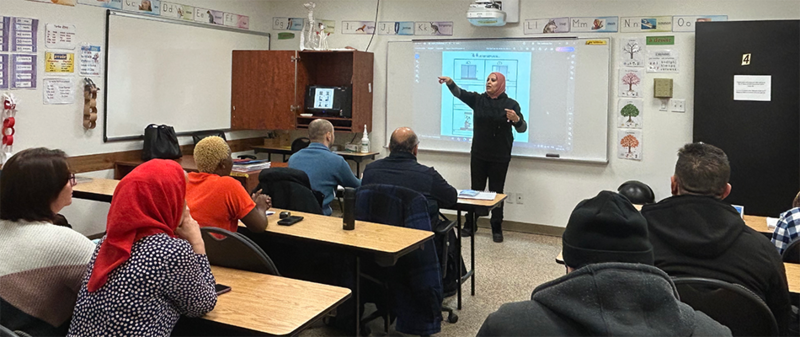
Aïcha: Yes, it's my reference point, because the teachers really helped me to speak and read. There were 13 of us in the class and we learned to communicate with each other!
Mikayel: The school was like our first family in Quebec. There were also other services available on site: job search, help with tax returns, help filling out documents. All of this helped us settle in fairly quickly. Moreover, it's important for an immigrant to know they can count on someone when they need support.
Our counselors are available to help you with your steps.